Snake River Gold Co
| Region | Rain Wild |
|---|
The mining company Garth and Thomas founded to hold and profit-share the Snake River Mine claim. Drafted as the Snake River Mine charter at the end of the 1014 season and officially registered under this name in Port Angelou that winter (see Sep 17, 1014 and Nov 19, 1014). Recapitalized in 1015 with Monteforte investment (below), diluting the founding charter to a 50% stake.
Original Charter (1014)
Written Sep 17, 1014 (Wet Season Wk 7), on the retreat down the Rain Wild River — a document sharing current and future profits with every expedition member who agreed to keep the mine's location secret and return to Port Angelou to help refine and sell the gold. All signed on; none of the men who would become the Snake Eaters deserted, unlike several other miners recruited in Tangletown.
| Member | Role | Shares | Status |
|---|---|---|---|
| Garth Banbury | Founder | 25 | Active |
| Thomas Triforte | Founder | 25 | Active |
| Augustus Ironwave | Riverboat captain | 8 | Active |
| Jeremiah O'Kiefe | Sergeant, Snake Eaters | 5 | Active |
| Bart Coldwell | Snake Eater | 2 | Active |
| Ferdinand da Rocha | Snake Eater | 2 | Active |
| Ibn Overseas | Snake Eater | 2 | Active |
| Pietro Conti | Snake Eater | 2 | Active |
| Caspian Adrianos | Snake Eater | 2 | Active |
| Kit Sawyer | Snake Eater | 2 | Active |
| Juan Ibarra | Snake Eater | 2 | Active |
| Lief Solberg | Snake Eater | 2 | Active |
| Marco Ferro | Snake Eater | 2 | Active |
| Marshal Bracknell | Snake Eater | 2 | Active |
| Nash Driftwood | Snake Eater | 2 | Active |
| Pedro Salazar | Snake Eater | 2 | Active |
| Ranulf de Coldale | Snake Eater | 2 | Active |
| Rosco One Eye | Snake Eater | 2 | Active |
| Walt Sutter | Snake Eater | 2 | Active |
| Heath Corrigan | Snake Eater | 2 | Deceased, Winter 1016 |
| Ridge Talbot | Snake Eater | 2 | Deceased, Winter 1016 |
| Yuri Volkov | Snake Eater | 2 | Deceased, Summer 1016 |
| 7 unnamed miners | Miner | 1 each (7 total) | Active |
| 3 unnamed miners | Miner | 1 each (3 total) | Deceased |
| Founders' total | 109 |
Per the charter, a deceased shareholder's shares don't revert to the company or pass to an heir — they pay into the Disabled, Widows and Orphans Fund, a standing company benefit for the families of members killed or maimed in the company's service.
Nebuchadnezzar the Learned and Lenora Bones are independent scholars/tutors, not Snake Eaters — they hold no charter shares.
The Monteforte Deal — Jan 15, 1015
Negotiated by Garth and Thomas with several senior Monteforte family members on Jan 15, 1015, after two weeks of runaway cabochon jewelry sales made the company's potential obvious:
- The Montefortes receive 109 shares — equal to the founders' original total — for a 50% stake in all company profits, including cabochon and gold sales retroactive to the 1014 season. Total company shares after the deal: 218.
- In return, the Montefortes fund a much-enlarged 1015 expedition: 3 riverboats, 160 men, a small stamp mill, a garrison force to build a fort at the mouth of the Snake River to defend the claim, and access to Monteforte connections at the mint to buy smelted gold at market rates.
- Kenneth Monteforte is the principal backer — he's gambling this year's investment yields profits large enough to fund a bid for Commodore of the Treasure Fleet next it sails (1017 or 1018). Since watching the 1015 season pay off, his attention has shifted almost entirely to the fleet. The mint (Serafina Monteforte's portfolio) handles the gold sales above.
- Edmund Monteforte gives his personal approval for the deal as head of House Monteforte.
Assets
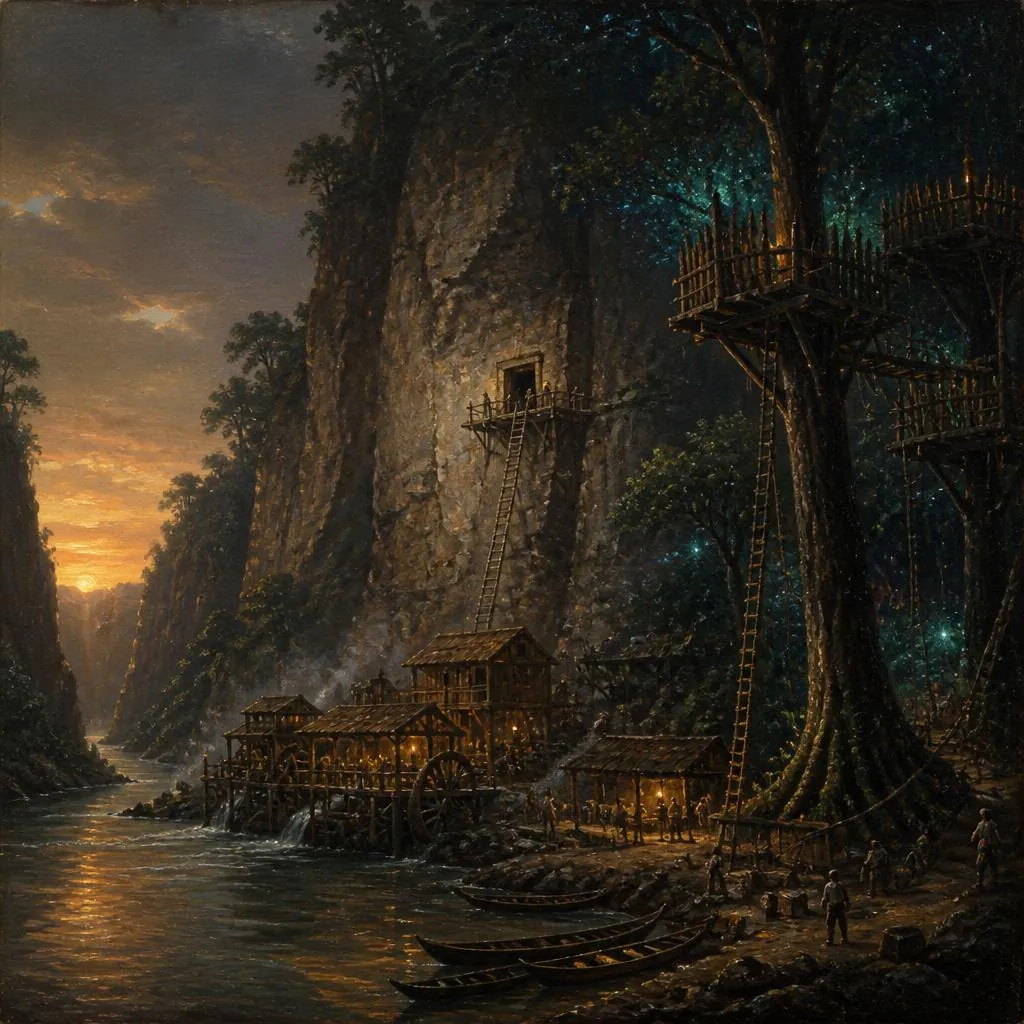
- Snake River Mine — the claim itself. Burned by the Kharzug at the end of the dry season and held as a bridgehead since: the minehead and stamp mills sit behind ramparts of felled trees, with three bridges rising across the gorge (seen Mar 20, 1017). Korag Gold Hand holds the ridge above it.
- Snake River Fort — built 1015 to defend it, expanded 1016
- The cliff elevator — Garth's counterweight hoist up the cliff face above the mine, built Aug 20, 1016 with Edward Monteforte's manpower on a route Thomas surveyed. The only quick way between the mine and the height; the alternative is a narrow defile half a day upriver.
- The watchtower on the height — the squat stone tower Edward raised at the head of the elevator the same season, built out of the mine's own stone waste and rough-coursed. It sees the whole bend of the river, both banks and the ground behind them, and stands above the smoke of any fighting in the valley. It came through the fall of the mine scorched on the outside and sound within.
What the company returns to the Rain Wild
The company has been doing half a serpent's job without noticing. The sea-serpents broke hard-rock gold and carried the region's gold back upstream; with the cycle stalled, the party are the only non-dwarves in the Rain Wild who can break hard-rock gold at all — and the only ones who tithe when they do.
Roughly 10–30% of each season's haul has gone back into the jungle, by habit and accident rather than policy:
- Low-grade crush ore discarded at the minehead, barely worth the portage out.
- The last blast of the season left in the mine when the camp breaks.
- Laden canoes lost on the river and the R1 portage way.
The discarded crush ore is what the Khordum want. Gold-bearing silt is brood-hearth feed, so the tailings tribute formalises what the company has been spilling into their valley for three seasons.
GM only: this is why the Song of the Wind bargains with the company rather than closing the seams against it. Extraction that returns a third and breaks locked rock is still the best thing that has happened to the regional gold cycle since the Cataclysm. Thomas's 10% tithe on the south-bank seam is unpaid and nothing has been mined there, so it buys no credit yet.
Profitability — Cabochon Jewelry
Assaying the 1014 gold in Port Angelou that winter, Garth realized the highest-grade specimen ore was worth far more cut as jewelry than melted for bullion — 10–100x the smelted value (Nov 26, 1014). Garth and Thomas seeded demand deliberately: gifting Lord Edmund a gold cabochon watch at the 1015 New Year's party (Jan 1, 1015), then working the social season until cabochon jewelry became the rage of Port Angelou (Jan 8, 1015) — selling faster than they could cut them, and making the case to the Montefortes for the investment above. The 1015 season closed very profitable (Nov 26, 1015): shares were paid out to every shareholder, founder and Monteforte alike.
See also
- Garth, Thomas — founders
- Snake Eaters — surviving 1014 expedition members
- Snake River — mine, fort, ruins
- Party-Facing Timeline — 1014 and Party-Facing Timeline — 1015 — full event sequence