Fae
| Region | Rain Wild |
|---|
The party are the only known humans who have made contact with the Fae in living memory.
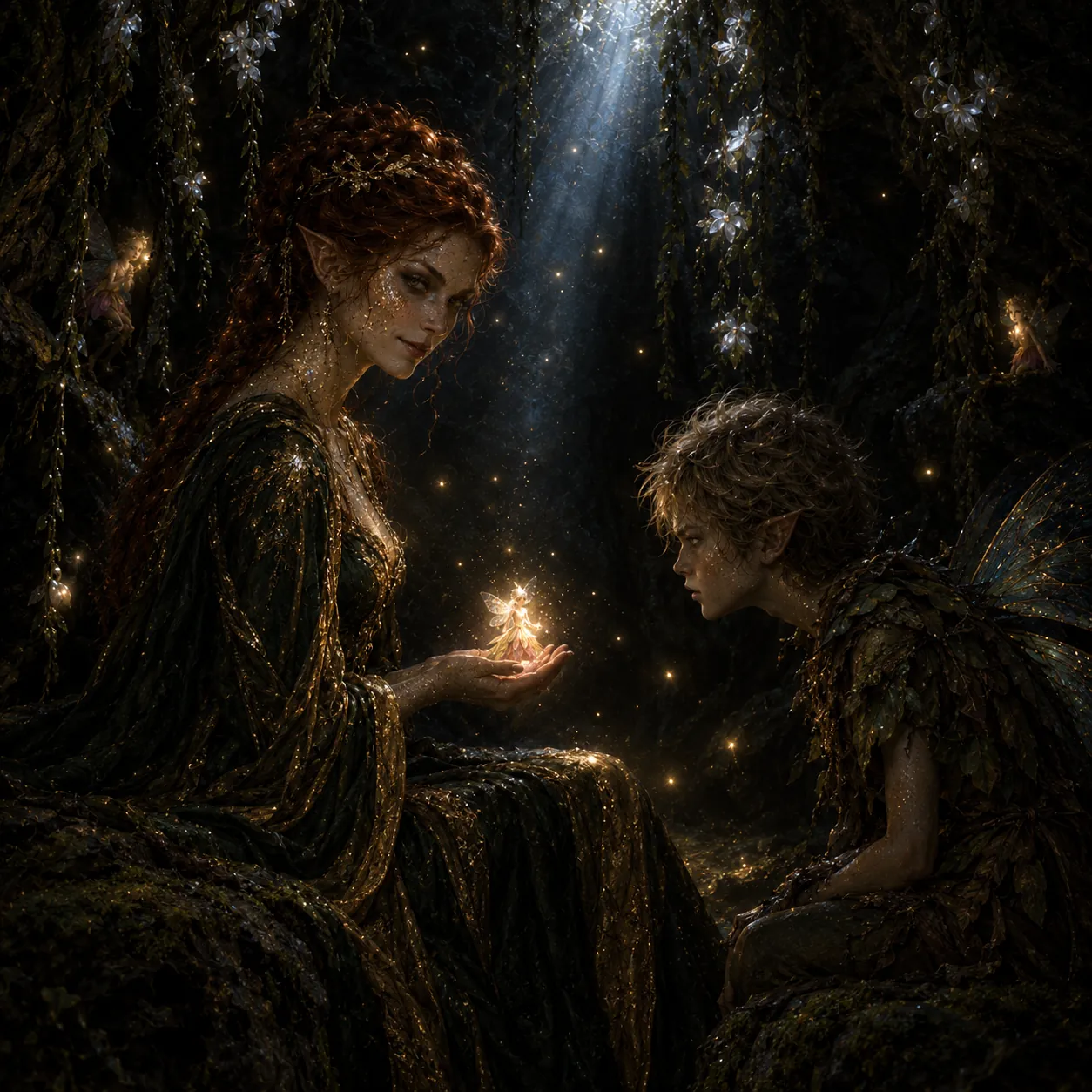
A long lived and mystical people, the Fae look like what humans describe as "Elves" — slender and graceful men and women with pointed ears and wild features usually standing a little more than 5' tall. Up close, their features are primal and sharp, and the eldest and most powerful have a metallic shimmer to their skin and hair that is unique to each individual.
These Elves have an unknown relationship to what humans would describe as "Faeries" and "Pixies", diminutive, winged creatures who live in the hollow hills alongside them. While strikingly similar in face and build, Faeries are quite small — about the size of an 8- or 9-year-old child, and have large, butterfly like wings. Faeries seem to be flighty and have an incomplete understanding of the world — WindFeather introduced Aerlaith as the Queen of the Fae, and was gently corrected. Pixies are significantly smaller, most only about 6 inches tall, and have dragonfly like wings.
Deeply powerful, the Fae access their magical power through song — resonance, timing and tone. This musical thread runs through their homes, rituals and everyday speech, so that it becomes hard to think of the Fae without thinking of their music.
The Fae seem to derive a mystical power from the bargains they make — Garth saw how the bargain Aerlaith made for the Iron Hand liturgy book seemed to shape her as a young Fae after the first Cataclysm.
The party has made several bargains with the Song of the Wind — Thomas's gold tithe, and agreement to seek out the dragon Vaelyr Vaun; Garth's vision of the Cataclysm and trade for the Iron Hand liturgy book; and Leo's vision of the Cataclysm and passage through Ael-Brynn. They have seen firsthand how seriously the Fae take them: at Ael-Brynn's Gallery of Returning Light, every word of a bargain is repeated back once by a shaped echo, so both sides know exactly what was said. Fae keep the letter of what they swear to, but the meaning can still turn out differently than expected.
Bargains also seem to be important to Faeries. WindFeather made a bargain to lead Leo out of Ael Brynn in return for 8 gold coins.
Gold matters to the Fae, but they don't appear to be personally greedy. The tithe Thomas swore was explicit that gold should be returned to the jungle — cast into rivers, seeded in groves, placed directly into the natural ecosystem of the foothills.
Numbers also appear to be important to the Fae. Odd (and especially prime) numbers seem to have a negative or fixative quality to bargains, while even numbers appear to imbue deals with a positive or changeable quality. WindFeather was explicit that 12 coins would be a "good" number to present to Aerlaith on first meeting, and insisted on taking fewer coins from Leo in order to receive an even amount.
Worldsong
- The song behind the world, first sung by Cynnodyn, whose voice empowers the world and the Fae (per Adlaes Ceredh).
- In the Cataclysm, which the Fae call Estrwyn, it gained a counter-voice. Since Cynnodyn fell silent, one note in every Fae song goes unanswered.
- Every mortal carries a very small part of it within them, and can call on it against Fae glamours (per Aelwenyth).
- A Pennar can sing it under the full moon, returning magic to those who sleep in the moonlight.
See also
- Song of the Wind — the Song the party has actually dealt with
- Canor Aerlaith — the bargains themselves